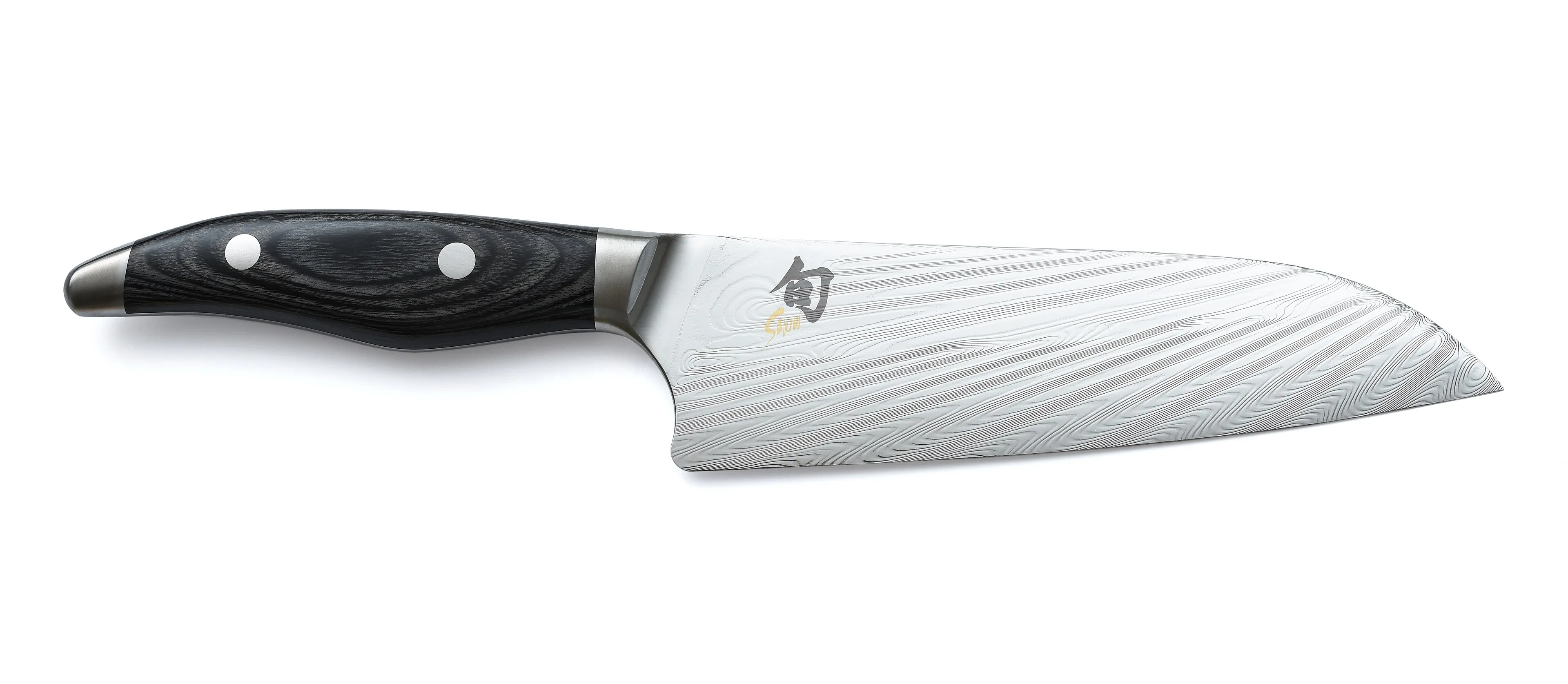
VG10, 67 layers
Santoku 17 cm
Three virtues: meat, fish, vegetable.
€119 Price includes tax. Shipping calculated at checkout.
Dispatched within 2 working days, delivered in 12 to 20 days.
The knives ship from the workshop that makes them. The stated delay is the real one, not an optimistic average.
14 day returns, no reason needed. 2 year legal guarantee of conformity.
- Steel
- VG10, 67 layers
- Hardness
- 60-61 HRC
- Edge
- 15 degrees per side
What it does
The santoku cuts straight. Lift, come down, the slice falls. Repeated over a kilo of onions, that motion tires the wrist less than rocking, and it is easier to keep even when you are learning.
The blade is tall, which buys two concrete things: your knuckles never meet the board, and the flat of the blade scoops the dice in one movement.
Why VG10
The same core as the gyuto: VG10 at 60-61 HRC, wrapped in 67 damascus layers. The edge lasts because the steel is hard, and the blade survives because the outer layers are soft.
What that changes day to day: a ripe tomato is sliced instead of crushed, and an onion is diced without sawing.
What it asks for
Warm water, dried straight away, stored outside the cutlery drawer. No dishwasher, no bones, nothing frozen. A pass on a stone every two or three months brings the factory edge back.
Specifications
| Blade length | 17 cm |
|---|---|
| Overall length | 30 cm |
| Weight | 178 g |
| Spine thickness | 2.2 mm |
| Core steel | VG10 |
| Cladding | 67 layers of damascus steel |
| Hardness | 60-61 HRC |
| Edge angle | 15 degrees per side |
| Handle | Octagonal pakka wood, red bolster |
| Origin | Blade forged in China, Japanese in style |
In the box
- The 17 cm santoku, sharp and ready to cut
- A rigid card travel sheath
- The care card
Frequently asked
Santoku or gyuto, which one first?
If you mostly cut vegetables and fish, straight down on a board, take the santoku. If you often work with meat and like a rocking motion, take the gyuto. Same job, different gesture.
What does santoku mean?
Three virtues. The name refers to the three things the blade handles equally well: meat, fish and vegetables.
Why does the tip drop?
Because the santoku is built for straight push cuts rather than rocking. The edge stays in contact with the board over almost its whole length, which stops slices from hanging on.
Is 17 cm enough?
Yes for anything that fits a home board. For a roast, a melon or a large squash, the 20 cm gyuto is more comfortable.
Are your knives made in Japan?
No, and we do not make them either. We buy them from a Chinese workshop specialised in VG10. The style and geometry are Japanese, the manufacturing is not.
Does it arrive sharp?
Yes. It leaves the workshop sharpened to 15 degrees per side, and we check the edge before dispatch.
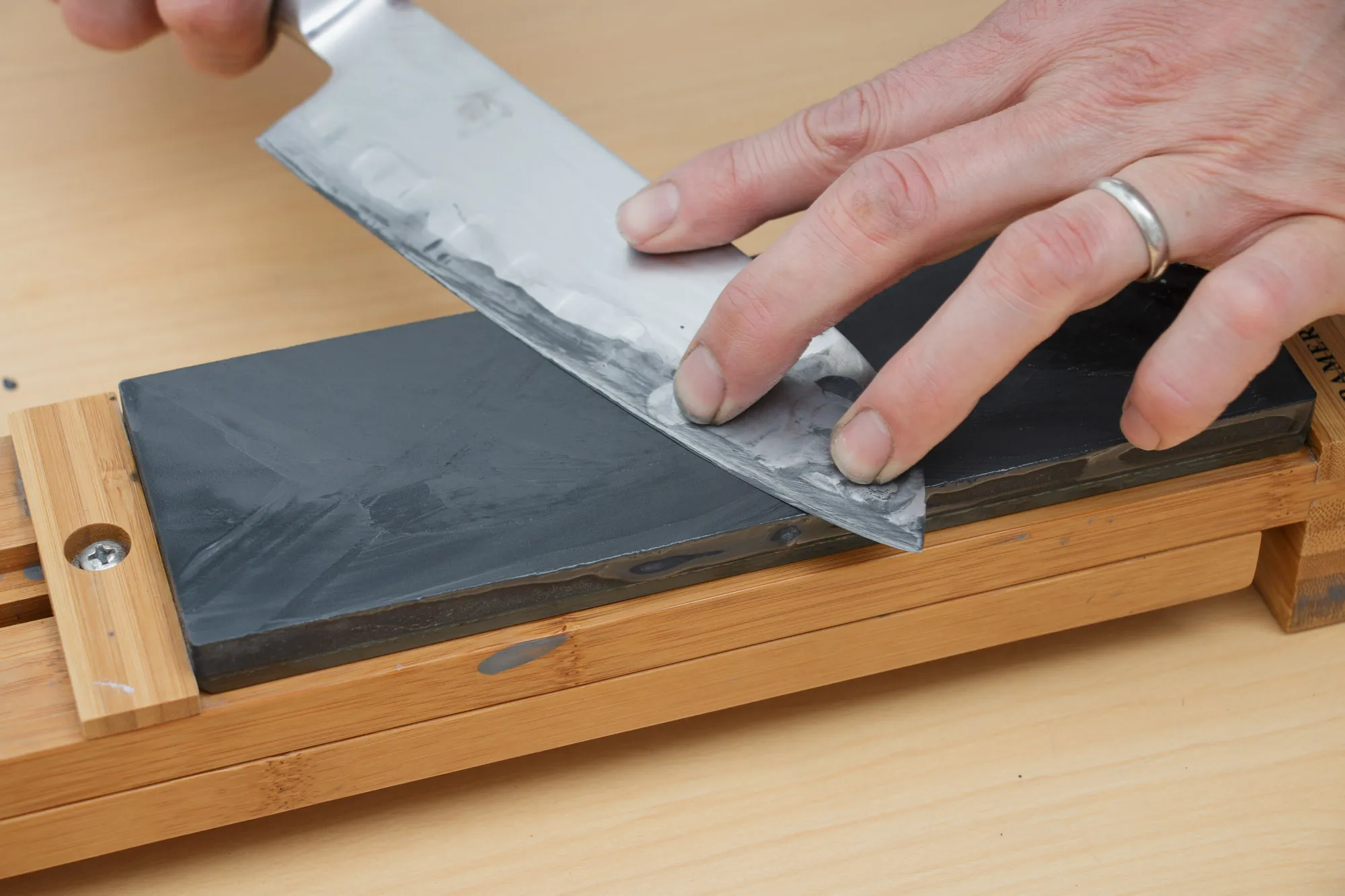
A blade needs upkeep
A 15 degree edge is restored on a stone, not on a steel. Ours is built for that angle.