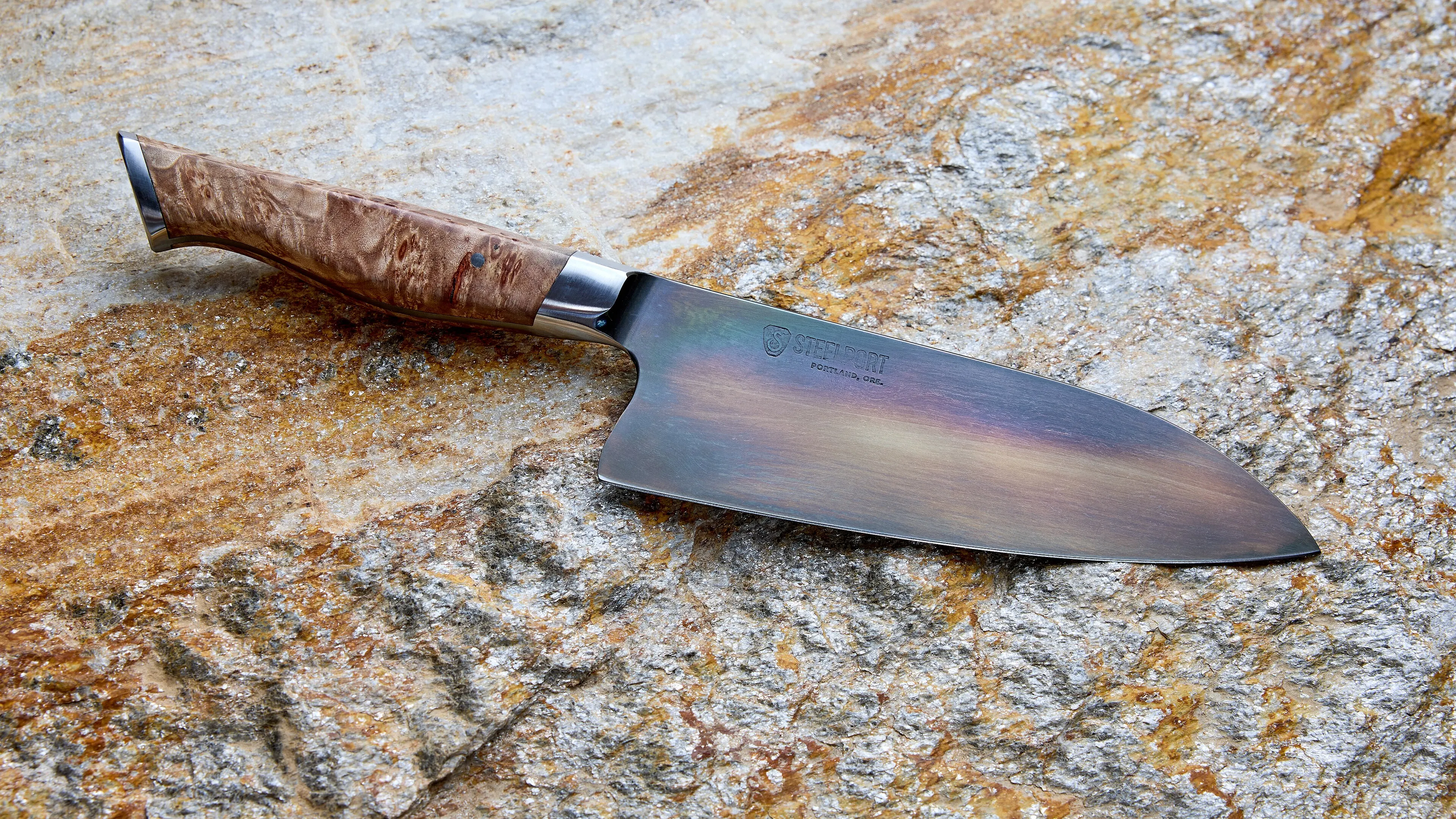
VG10, 67 layers
Gyuto 20 cm
The Japanese knife that does eighty percent of the work.
€129 Price includes tax. Shipping calculated at checkout.
Dispatched within 2 working days, delivered in 12 to 20 days.
The knives ship from the workshop that makes them. The stated delay is the real one, not an optimistic average.
14 day returns, no reason needed. 2 year legal guarantee of conformity.
- Steel
- VG10, 67 layers
- Hardness
- 60-61 HRC
- Edge
- 15 degrees per side
What it does
The gyuto is the knife that stays on the board. It slices onion, breaks down chicken, cuts leek on the bias and gets through squash without a change of tool. It is the most versatile blade in a kitchen, and the one a cook picks up without thinking.
The geometry explains the rest. The belly is gently curved: enough for a rocking motion, not so much that it loses contact with the board on a straight push cut. The tip is fine and low, so it works around joints and tendons without forcing.
Why VG10
VG10 is a high carbon stainless steel. It takes 60-61 HRC, well above the 56 or so of common European kitchen steel. In practice: the edge lasts longer, and it can be taken finer.
The 67 damascus layers around it are not decoration. They wrap the VG10 core in softer steel, which absorbs part of the stress and keeps a hard blade from becoming a brittle one. The pattern is the visible trace of that assembly, revealed by an acid polish.
What it asks for
A hard blade does not forgive rough handling. No bones, no prying, no soaking. In return, it cuts for years.
Specifications
| Blade length | 20 cm |
|---|---|
| Overall length | 33.5 cm |
| Weight | 196 g |
| Spine thickness | 2.2 mm |
| Core steel | VG10 |
| Cladding | 67 layers of damascus steel |
| Hardness | 60-61 HRC |
| Edge angle | 15 degrees per side |
| Handle | Octagonal pakka wood, red bolster |
| Origin | Blade forged in China, Japanese in style |
In the box
- The 20 cm gyuto, sharp and ready to cut
- A rigid card travel sheath
- The care card
Frequently asked
How is a gyuto different from a Western chef knife?
The gyuto is the Japanese cousin of the chef knife. The blade is thinner, harder, and ground to 15 degrees per side instead of 20 to 22. It cuts cleaner and asks, in return, for a tidier technique and a stone rather than a honing steel.
Is 20 cm too big for a normal kitchen?
No. Twenty centimetres is the reference length for a gyuto, including on a standard board. Shorter than that, you lose the rocking motion the blade is built for.
Are your knives made in Japan?
No, and we do not make them either. We buy these knives from a Chinese workshop that has worked VG10 for more than fifteen years, and sell them under our own name. The style, the geometry and the steel are Japanese, the manufacturing is not, and we write that wherever the question comes up.
Can it go in the dishwasher?
No, and that holds for any hard blade. Heat, alkaline salts and knocks against other cutlery chip the edge and attack the handle. Warm water and a cloth are enough.
How often should it be sharpened?
For daily home use, a pass on a 1000 then 6000 grit stone every two or three months keeps the factory edge. In between, a ceramic rod realigns it without removing metal.
Does it arrive sharp?
Yes. It leaves the workshop sharpened to 15 degrees per side, and we check the edge before dispatch.
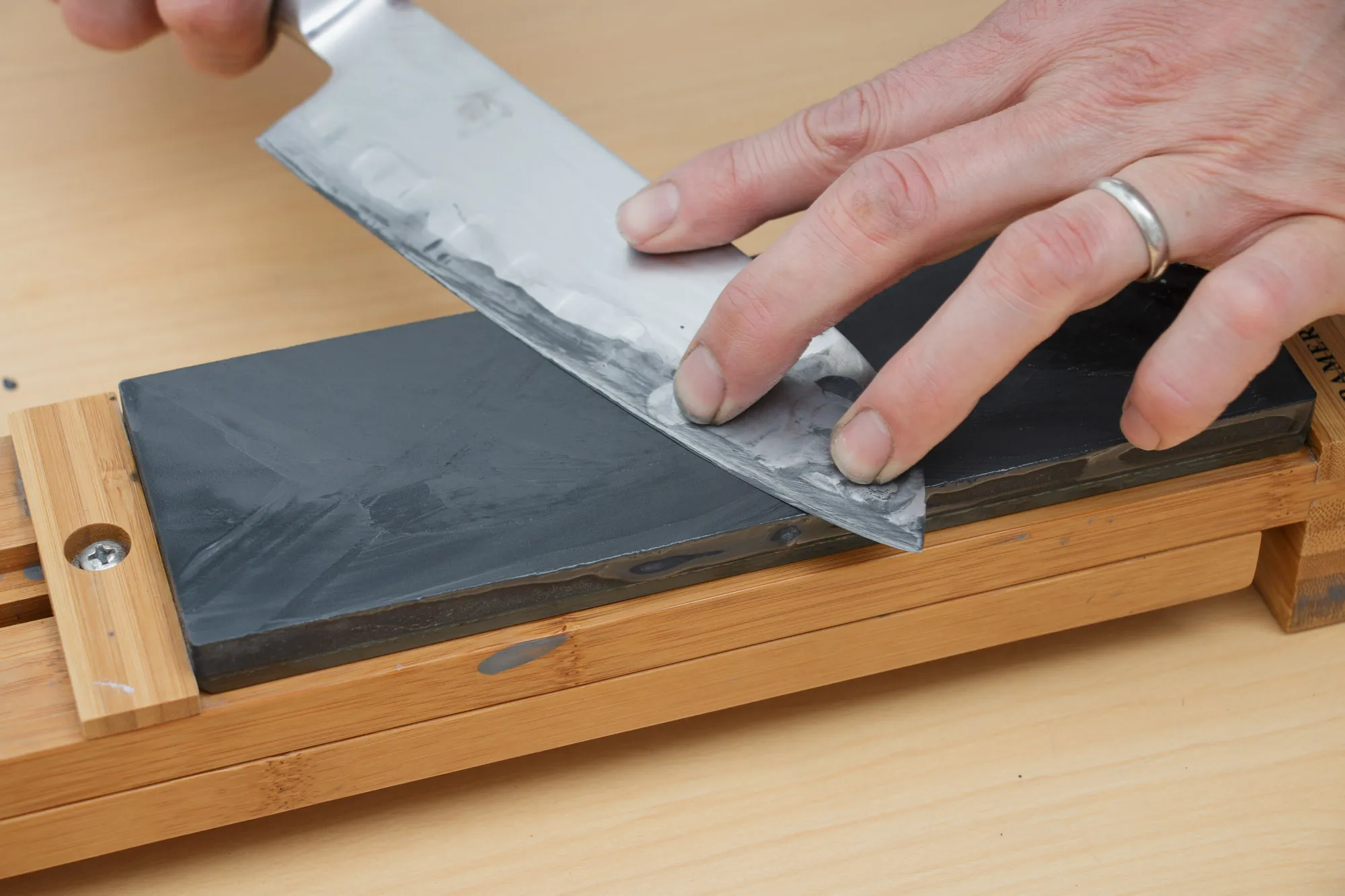
A blade needs upkeep
A 15 degree edge is restored on a stone, not on a steel. Ours is built for that angle.